Monday, 18 April 2011

Topic 5 - Business Model

1) Take a few notes and provide some examples of businesses which fit the models below.
  • Infomediary: The word infomediary is formed from a combination of the words information and intermediary. An infomediary is a Web Site that gathers and organizes large amounts of data and acts as an intermediary between those who want the information and those who supply the information. There are two types of infomediaries. Some infomediaries, such as Autobytel.com and BizRate.com, offer consumers a place to gather information about specific products and companies before they make purchasing decisions. The infomediary is a neutral entity, a third-party provider of unbiased information; it does not promote or try to sell specific products in preference over other products. It does not act on behalf of any vendors. The second type of infomediary, and one that is not necessarily Web-based, is one that provides vendors with consumer information that will help the vendor develop and market products. The infomediary collects the personal information from the buyers and markets that data to businesses. The advantage of this approach is that consumer privacy is protected and some infomediaries even offer consumers a percentage of the brokerage deals.
  • Affiliate: The affiliate model provides purchase opportunities wherever people may be surfing. It does this by offering financial incentives (in the form of a percentage of revenue) to affiliated partner sites. The affiliates provide purchase-point click-through to the merchant. It is a pay-for-performance model: if an affiliate does not generate sales, it represents no cost to the merchant. The affiliate model is inherently well-suited to the web, which explains its popularity. Variations include banner exchange, pay-per-click, and revenue sharing programs. An example of this is Amazon.com.
  • Subscription: The basic notion here is that the customer is charged a periodic fee for a goods or service. Subscription is a very important facet of the internet, because we’re seeing more and more things which were formerly products, things that were sold to the customer as a product – and in particular in the area of software, like various applications sold as products installed on your computer – are now starting to transition quite rapidly to services. The fees charged for subscriptions are also set, regardless of the usage. With this type of business model providers are able to trace potential grow and decline of the subscription model as with the fixed price they are guaranteed a certain amount of revenue. There are five successful models for subscription website topic selection. These include: Existing newsletter topics,Trade association, Career advancement, Personality based/insider tips, Downloadable product library.
  • Utility: The utility business model is based on a metering or pay-as-you-go approach. This is broken up into two categories. The first is metered usage which measures and bills users based on actual usage of a service. The second is metered subscriptions which allows subscribers to purchase access to content in metered portions (e.g., numbers of pages viewed). An example of this is Slashdot. 
2) What is the business model for TWITTER?

The business model for TWITTER would be the community model with the social networking services.

3)How does Australia rate ?
  • What is the Mobile phone use /100 population - compare Australia, USA, China, India, Your Country ?
Australia: 113.8
USA: 90.8
China: 116.7
India: 43.8
France: 95.5
  • Internet use / 100 population - compare Australia, USA, China, India, Your Country

Australia: 74.3
USA: 78.0
China: 28.9
India: 5.1
France: 71.6
  • Compare main strengths and weaknesses of Australia or your home country in the survey
Strenghts: Political and regulatory environment (5.6), Infrastructure environment (5.1) and Individual readiness (5.1).
Weaknesses: Business usage (4.4), Government readiness (4.6) and Market environment (4.7).
By looking at the survey in all categories, France is good if we take the scale from 1 to 7. The country is generally situated in the average, around 5.
  • What does the survey suggest to you about the Information Technology readiness of Australian business compared to Australian consumers?
Information Technology readiness of Australian business is ranked lower in the world at 22 compared with Information Technology readiness of Australian consumers who rank 16 in the world. This suggests that Australian businesses are not as Information Technology ready as Australian consumers. 

Monday, 11 April 2011

Topic 4 - Web Analytics


1) Looking at the site usage, what does the terms visits, page views and pages/visit mean? What does the bounce rate mean and does it vary
much from day to day?
  • Visits: The number of visits your site receives is the most basic measure of how effectively your promote your site. Starting and stopping ads, changing your keyword buys, viral marketing events, and search rank are some examples of factors that influence the number of visits your site receives. 
  • Pageviews: Pageviews is the total number of pages viewed on your site and is a general measure of how much your site is used. It is more useful as a basic indicator of the traffic load on your site and server than as a marketing measure. 
  • Pages/Visit: It is the average of pages viewed during their visit. 
  • Bounce rate: Bounce rate is the percentage of single-page visits (i.e. visits in which the person left your site from the entrance page). Bounce rate is a measure of visit quality and a high bounce rate generally indicates that site entrance (landing) pages aren't relevant to your visitors. The bounce rate does vary much from day to day. (Foliospace.com - 02/04/2011: 38.51%; 03/04/2011: 40.08%; 04/04/2011: 32.75%).
2) Now look at the traffic sources report. What are the three sources of traffic and where has most of the traffic come from?

The three sources of traffic are direct traffic, referring sites and search engines.
The most traffic for Foliospaces.com come from Direct traffic (43.88%).

3) What was the most popular web browser used to access the site?

Internet Explorer was the most popular browser used to access the site Foliospaces.com (51.56% visits).

4) How many countries did visitors to Foliospaces come from and what were the top four countries?

There were 75 different countries which visited Foliospace on the 5 April 2011. However, the four countries in order are Australia, United States, United Kingdom and New Zealand.

5) Having clicked every possible link on my analytics, make a few comments on:

(a) What you can track 
On Google Analytics we can track Visitor information such as:
Visitor Trends

  • Number of visitors
  • Number of absolute unique visitors
  • Number of page views per visit
  • Number of page views, average
  • The average time spend on the Web site
  • The bounce rate
Visitor Loyalty

  • Number of times one person has visited the Web site
  • How recent the last time a visitor visited the Web site
  • Length of visit
  • Depth of visit
Browser Capabilities
  • Browser type
  • Operating System
  • Browser and operating system combinations
  • Screen colours
  • Screen resolution
  • Flash version
  • Java support
Network Properties
  • Network locations
  • Hostnames
  • Connection speeds
(b) What you can track over time
We can track all this information over time through the timeline feature.


(c) What you can’t track
We can't track demographic figures such as age, income, gender and occupation.

6) What do the following terms mean? These are just a few, you may like to add some more and perhaps include them on the Moodle glossary.


High bounce rate: A high bounce rate generally indicates that site entrance (landing) pages are not relevant to your visitors.

Key words: A significant word or phrase, relevant to the web page or document in question.

Average Page Depth: The average number of pages on a site that visitors view during a single session.

Click through rate: The number of times an ad is clicked on, divided by the number of impressions it receives.

Click: In Google Analytics reports, a 'Click' refers to a single instance of a user following a hyperlink from one page in a site to another.

Cookie: A small amount of text data given to a web browser by a web server. The data is stored on a user's hard drive and is returned to the specific web server each time the browser requests a page from that server. Cookies are used to remember information from page to page and visit to visit and can contain information such as user preferences or shopping trolley contents furthermore Cookies can note whether a user has logged in so that they do not need to authenticate again as they navigate through the site.

Impression: A display of a referral link or advertisement on a web page.

Hyperlink: A hyperlink points to another location in the same or another HTML document. This link there for navigates a user to another section of the page or to a new page or site altogether.

Navigation: Navigation refers to how you find your way from one page to another on a Web site. 

Pageview: A page view is an instance of a page being loaded by a browser.

Session: A period of interaction between a visitor's browser and a particular website, ending when the browser is closed or shut down or when the user has been inactive on that site for a specified period of time.

Unique Visitors (or Absolute Unique Visitors): Unique visitor is when the website identifies the user using an IP address.

URL: URL (Uniform Resource Locator) is the combination of the protocol name and the domain name. This is used to uniquely identify and navigate to a web page.


Visitor: A Visitor is a construct designed to come as close as possible to defining the number of actual, distinct people who visited a website.

Visitor Session: A Visitor Session is a defined period of interaction between a Visitor (both unique and untrackable visitor types) and a website.

Comparison shopping: Comparison shopping is when the shopper compares price, quality, features etc of one item against others before purchasing the item.

Monday, 4 April 2011

Topic 3 - Digital Design

1. In two paragraphs explain why a customer centric Web site design is so important, yet so difficult to accomplish.

A customer centric website design is so important to a company because they only care about what is important to them – getting whatever information, services, or products they came to the website for. Web sites used to be nothing more than electronic brochures. However, the Internet has become a very interactive environment for users. That is the reason why websites need to be specifically built in a way that captures the attention of visitors and keeps them coming back.

Indeed, there are four important factors that companies need to pay attention to and to follow while building a customer centric website:

  • Customer: First of all we have to keep in mind that the customer has the power to leave or stay / to buy or not. The website has to provide customers' need such as: easy navigation, main information, convenient, entertainment, etc. Website need to focus on customers so that they can have a good impression on the website to come back then become a loyal customer.
  • Design: The design is all about the visual appearance and the site map. Nowadays, many website uses flash animation,  color palettes, page layout and attractive imagery in order to attract visitors. There is also the issue of usability, navigation, and the site's architecture (hierarchy of the website such as home page, sub-pages, etc.)
  • Content: The content of the website should be focused on communicating the message that the company wants visitors to receive. It's a kind of online marketing, the content needs to be engaging, informative and  entertaining. 
It is difficult to accomplish a customer centric web design because customers change trends along the time,so the website needs to be update every time and it is difficult to forecast it. Moreover, is it difficult to display information on a website because an online product is represented as an image, that is to say something unreal. This product can not be tried, examined or touched and for the customer it is an inconvenient when buying online.
Finally, it is difficult to know what are customers expectations through a website that is the reason why many companies have to make several surveys before creating a customer centric website.

2. Define the term 'presence'. Write an additional paragraph that describes why firms that do business on the Web should be more concerned about presence than firms that operate in the physical world.

The term "presence" has different meaning. It can be defined as "the state or fact of being present; current existence or occurrence". In my opinion firms that do business on the Web have to be more concerned about presence than firms that operate in the physical world because firms in the physical world have institution, shops and people can see the product, the employee physically so it is easier for the business to be recognized. However, those businesses that operate over the web need to be able to attract customers to their website with advertising on search engines, banner ads and domain names as well as offering great products and services at reasonable prices that have a competitive advantage over major competitors. We can notice that many of them use the "community" or group" aspect to enable customers to have a general discussion related to the firms product or service through Forums, Newsletters. This kind of general discussion is an advantage for the firms to improve their product/service/website thanks to online customer's feedback.

3. Write three paragraphs to briefly describe the things that Real Estate Agents can best accomplish through (1) their web sites (2) Mass media advertising (3) Personal contact.

By using internet, Real Estate Agent have the opportunity through there websites to reach more customers because t
hrough a real estate website agencies, they can display a greater number of listings as appose to a newspaper. It also offers many options such as photos, videos and virtual tours. Contrary to a newspapers, it easier for the customer to find a property thanks to search option that give the users a quick and targeted way of searching for properties that suit there needs.

A Real Estate Agent will use mass media advertising to have a presence to a large scale market and to show to customers their efficiency and reaction in dealing with potential buyers. They generally use
 mass media to advertise their company on television, the radio, the newspaper and catalogues. It is also useful for reaching customers who do not have access to the internet. 

Personal contact for a Real Estate Agent is very important in building a relationship between agent/seller, and agent/buyer. As the agent is willing to deal with the customer on a one to one basis to help with any problems, questions or misunderstandings they may have. That is the reason why Personal contact is all about direct assistance to customers but compare to the two others type, t
his type of selling can be more informative and it allows the Real Estate Agent to give more details.

Sunday, 20 March 2011

Topic 2 - Navigating the Web

Part 1 - Navigation

a) What are the four main points Michael Rappa makes about search?

  • The first main point Michael Rappa makes about search is that nowadays, as data collection and storage is more and more cheap, there is through Internet a lot of information available. The vast amount of information/data collected on this digital world leads to an enormous database in which people can access to. Moreover, with data being not expensive this causes a lot of data/information on the internet not necessarily being significant.
  • Secondly, search engine is a collection mechanism for adding data into that database. The fact that The data on the internet increases everyday, it is difficult for the collection mechanisms for search engines  to crawl and collect all of the information that’s out there. That is the reason why databases represent just a portion of the vast amount of digital information. Finally, Search engines do not always have every part of data that is available on the internet. 
  • Thirdly, search engine is a search protocol that enables users to query the database. Indeed, users are unaware of how to narrow their search which would result in more accurate results because some of them are not aware of ways to search to their best advantage. They generally put a word, or a question, or a few words in the toolbar on a search engine. To resume, a search engine is composed of a database, and there has to be some mechanism for collecting that data and the search protocol is used to query the database. So "never trust a computer, a computer is a machine" (Pr. Amir DHIA).
  • Finally, the fourth main point that Michael Rappa makes about search, it’s the ranking algorithm that determines how the results are presented to the user. That is determine the order of the list of result after people have searched for a key word or phrase.There are generally millions of websites in the list of result. Often the first page result is paid placement.
b) Watch or read the Marissa Mayer interview. Write a paragraph or two, on four points made by Marissa Mayer, that you think were the most interesting or significant for business. 

Web advertisements on the Google search page is an interesting point for business. However, many companies cooperate with Google to advertise their business when people browse search engines. As Google is a search engine, people may pay attention to ads when searching information. Moreover, every ads are sorted and posted according to people's research. For example: if we write "Iphone" on Google's toolbar, on the right side of the list of result page, we can notice many advertising are related to Iphone.

Another interesting point that Marissa Mayers talked about is that Google uses everyone's ideas even if it comes from an employee whatever his position. It is an ineresting point for a business to have recognition for an employee that can leads to better productivity and satisfaction in the company. ("you know every Googler has an idea. Googlers are what we call the Google employees. Every Googler has an idea as to something that’s not being done right now that could be done" - Marissa Mayers)

In my opinion when Marissa Mayers point out the fact that all business starts with an idea and ideas comes from everywhere, I'm really totally agree with her. From my personal point of view, a company has to be open-minded to anything and above all on their customers. That is the way to improve a product/service by listening everyone's ideas.

Finally, the last point that is significant for the business is when Marissa Mayers states "there is a lot of different elements of the culture that have really fostered innovation". The main point of this is that they like to work with really small teams. Indeed, work with a small teams is more efficient than to work in a large one. I think this concept is a gain of time in terms of work achievement and it's easier to communicate between group member. In that case employees are more agile and more involve on their work.

Part 2 - History of the Internet


a) So what are the 6 webs?

  • The“far” web as defined by the typical TV viewer experience.
  • The “near” web or desktop computing.
  • The“here” web or mobile devices with personal information one carried all the time.
  • The “weird” web characterized by voice recognition systems.
  • The “B2B” web of business computers dealing exclusively with each other.
  • The“D2D” web of intelligent buildings and cities.
b) Could there be more?

I think the 6 webs cover all kind of digital technologies but in the future there is maybe the "reality" web that is to say web through a hologram (like R2D2 in Star Wars, cf: http://www.youtube.com/watch?v=jLx0BCjtxx8)


c) What does it mean for business?

This means businesses have to remain constant and innovative in order to adapt to changes in the future.

Thursday, 17 March 2011

Topic 1 - Introduction to E-Commerce

1) Internet risks – give examples of four things that can go wrong with a transactional site?
  • Trust and Authenticity: In e-commerce, the issue that attracting most attention is verifying the identity and authority of the (virtual) person. The technical perspective is mostly about electronic signatures, cryptography, secure authentication servers, etc... we can notice that there are many blackmail and fraud opportunities, which create a different set of issues for authenticity.
  • Fraud: Fraud is a major issue when the transaction is made on the internet. One of the biggest concerns was the threat of credit cards being stolen through the online purchase procedure.  There is always an opportunity for this to occur.
  • Security: Nowadays, many threats are spreading over the web such as Trojans, Viruses, Spywares, SPAM,...
  • Hacking: Hacking is the process of gaining unauthorized access to a computer system. There are many ways this can be accomplished, but the three most common are:
    1. Exploiting preexisting bugs in the target system software to gain access.
    2. Taking advantage of a system's poorly configured software security protocols to gain access.

2) Write down a definition for each:

a) E-commerce is one specific aspect of an e-business focused on either buying or selling products or services over the Internet. 
b) E-business is about how organizations are using Internet technologies to fundamentally change the way they do business:
  • How companies use the Internet to run themselves more efficiently.
  • How companies use the Internet to interact with others (suppliers, customers, and partners) more efficiently.

3) What is the difference between buy side and sell side eCommerce?
  • Sell-Side: focused specifically on selling products and services over the Internet typically through an electronic storefront or website.
  • Buy-Side: focused specifically on consolidating purchasing for manufacturing components and MRO (Maintenance, Repairs & Operations) products over the Internet typically by using a Web-based supply chain and delivery solution.

4) Describe the different types of e-Business.

  • B2B (Business to Business): A transaction that occurs between two companies, as opposed to a transaction involving a consumer. The term may also describe a company that provides goods or services for another company.
  • B2C (Business to Consumer): A transaction that occurs between a company and a consumer. The term may also describe a company that provides goods or services for consumers.
  • B2G (Business to Government): Feedback to government businesses and NGO's.
  • C2B (Consumer to Business): Means through which consumers decide what they want to pay, and the vendors decide whether or not to accept.
  • C2C (Consumer to Consumer): Means through which consumers interact with other consumers through, for example, online auctions.
  • C2G (Consumer to Government): Feedback to government through pressure group or individual sites.
  • G2B (Government to Business): Refers to a government agency communicating with or purchasing products or services from a business.
  • G2C (Government to Consumer): The communication link between a government and private individuals or residents.
  • G2G (Government to Government):  is the electronic sharing of data and/or information systems between government agencies, departments or organizations. The goal of G2G is to support e-government initiatives by improving communication, data access and data sharing.
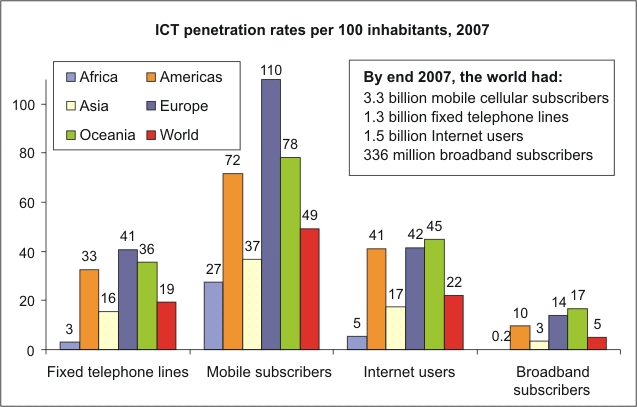
5) Which digital technology has the highest penetration rate? Explain and source your answer.


The digital technology which has the highest penetration rate is mobile phones. The impressive growth in the number of mobile cellular subscribers is mainly due to developments in some of the world’s largest markets. The economies of Brazil, Russia, India and China are expected to have an increasingly important impact in terms of population, resources and global GDP share. These economies alone are expected to account for over 1.3 billion mobile subscribers by the end of 2008.


ITU recently published two regional reports for Africa and Asia, which indicate how mobile telephony is changing peoples’ lives. Apart from providing communication services to previously unconnected areas, mobile applications have opened the doors to innovations such as m-commerce to access pricing information for rural farmers and the use of mobile phones to pay for goods and services.


6) List: Four drivers to adoption of sell-side e-commerce by business.

The drivers to the adoption of sell-side e-commerce by businesses are:
  • Free Marketing
The marketing cost are reduced due to the sales and advertising is done online.

  • Expand their market
It is beneficial for businesses to utilize sell-side e-commerce to increase the amount of consumers they can target across a larger geographic area.

  • Decrease amount of inventory needed/free-up capital
If a business were to utilize sell-side e-commerce, their customers would be able to make purchases online. Therefore the company would be able to implement a JIT distribution system reducing the amount of inventory they would need to store.

  • Reduce the risk of loss
By doing business through sell-side e-commerce businesses will be able to reduce the risk of loss to the business. 

7) Four barriers to adoption of sell-side e-commerce by business.
  • Identification of products or services can be tricky due to poor quality content which includes descriptions and images as well as poor searching capabilities. 
  • Cultural barriers which includes internet accessibility and language barriers. 
  • Customers fear of change. Some customer would be more inclined to use the internet as a way to purchase goods and services as opposed to others. Therefore the customer base could be reduced by the adoption of sell side E-Commerce however this could depend on the target market. 
  • Lack of technical competency. The customer might not have technical knowledge or understanding to use the online store
8) Write a a paragraph or two describing the current importance of ICT in your professional life.


First of all, I have noticed that Internet facilitates many things in our lives in terms of communication. Nowadays, with the launch of the Web 2.0 people can share and spread there ideas, opinions, videos, music,...Thanks to this technology, many businesses make profits through the whole world and everyday there is new opportunity and new concepts in making a business.
In my opinion, ICT is a fundamental need for each of us. The communication's speed and quality is a gain of time and time is really important in our everyday life.